• Reading Kawabata on AAA Batteries

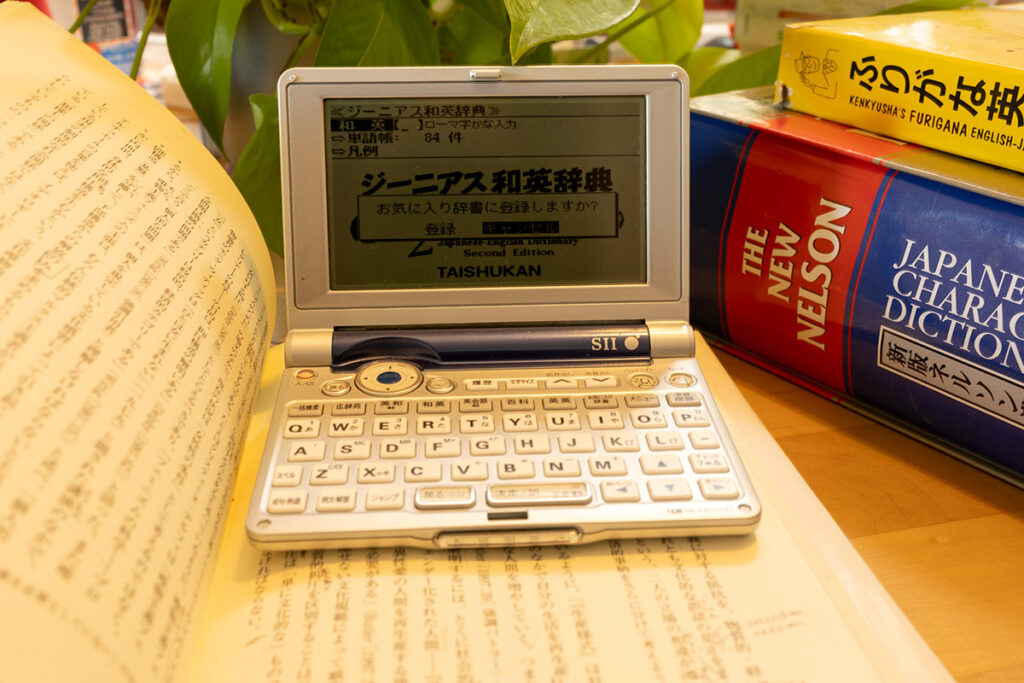
    A vintage silver Seiko SR-MK4100 electronic dictionary open on a wooden desk. It sits on top of an open Japanese book, flanked by a thick red 'New Nelson' Japanese-English Character Dictionary and a yellow 'Furigana English-Japanese' dictionary. The electronic screen shows the 'Genius' dictionary interface in monochrome.

    Guilt is a powerful motivator for me. Ever since I began studying German, I’ve felt a lingering sense of guilt for not dedicating more time to my Japanese. While I can express myself in daily conversation, I know there is significant room for improvement. I’ve also long felt the need to read my favorite books and short stories in their original Japanese—specifically Kawabata Yasunari’s The Izu Dancer (伊豆の踊り子). I once even took the time to hike the actual trail where the story takes place, yet I had still never read the book in its original language.

    As my guilt finally caught up to me, I committed to spending at least 15 minutes a day immersing myself in Japanese. It doesn’t have to be long—I often alternate between reading and watching YouTube—but it feels good to reconnect. Picking up a word I’ve never seen before remains deeply satisfying.

    Since I already have a LingQ subscription, I usually start there. However, the experience is often fraught with modern “friction.” Many books I want to read are still under copyright, and navigating Digital Rights Management (DRM) is a headache. Even once a text is imported, the software struggles with the lack of spacing in Japanese; unlike English or German, where words are clearly delineated, the algorithm often “slices” the vocabulary incorrectly, making look-ups impossible.

    Rather than turning to another phone app or a desktop tab, I reached for my vintage Seiko electronic dictionary, bought during my student days in Japan 20 years ago. While I find paper dictionaries nostalgic, they are simply too slow for a 30-minute immersion session. Remarkably, this 20-year-old piece of technology still works perfectly. I found myself reading exactly as I did before the days of smart phones—no software updates required, and zero pop-up ads.

    The device features a “Sil-Card Red” slot for specialized, SD-sized cartridges. While I don’t have the need for one of these cartridges today, there is a sense of permanence in this technology. If I did have one, it would likely still function without needing a server or a tech company’s permission. It is a beautifully distraction-free tool in a world where every other app competes for my attention. It’s disconcerting how much modern technology promises, yet we seem to own less of it than ever before. My smartphones eventually become obsolete or “brick” when support ends, but this Seiko remains a tool I truly own.

    The only “distractions” the machine ever offered were the options for 夢占い (dream fortune-telling) and 相性事典 (compatibility dictionary) cartridges. On my student budget, I stuck to the pre-loaded academic dictionaries.

    While the world moved on to cloud computing and ephemeral licenses, this device remained. It’s the same one that navigated the surreal landscapes of Murakami with me years ago; today, powered by two simple AAA batteries and a logic that doesn’t expire, it’s simply waiting for the next page of The Izu Dancer.

    April 16, 2026
    Denshi Jisho, Digital Minimalism, Japanese Learning, Kawabata Yasunari, Seiko SR-MK4100

  • Searching for My People

    Day 479 of German

    I’m about to embark on a long flight to meet people who share my intense interest in language learning. I know I’ll be surrounded by individuals who speak far more languages than I do. In a way, this entire trip feels like a search for my own people—a community that understands this unique passion.

    For this journey, I’ve packed two very intentional items: my Internet Phone Book and the bilingual German-English edition of Hermann Hesse’s Demian.

    Bringing the Internet Phone Book, a collection of sites that make up the “poetic web”—places where people share their genuine feelings without seeking likes or retweets—is important. Somehow, having photos of this book in Taiwan, at the language conference I’m attending, feels like the right juxtaposition. It’s a contrast between the silent, personal web and the physical space where people gather to share their passion for languages aloud.

    I really don’t have much time to read fiction, and the little I’ve read of Demian so far is quite nice. I feel like I’m cheating a bit by relying on the bilingual version, and honestly, I plan on reading the English text more than the German during the flight.

    Despite the self-imposed academic pressure, I think this will ultimately be a trip filled with rich feelings—the quiet solitude of the flight, the connection with new people, and the beautiful sounds of many different languages.

    November 8, 2025
    Authenticity, Demian, German Learning, Language Community, Travel Reflection

  • The Serendipity of the Railway Tie

    Day 470 of German

    It was a typical German study day. I watched the Tagesschau (the evening news) and looked up all the unfamiliar words. I sometimes question whether it’s truly effective to study German this way, as news media doesn’t follow the logical, progressive structure of a textbook. It often forces me to encounter words that, while vital to a news story, I’m not likely to use in everyday conversation.

    Yesterday offered a perfect example of this: the word die Schwelle (Bahn), meaning a railway tie or sleeper. The news segment involved an investigation into a train derailment reportedly caused by faulty ties. I eventually had to search the topic in English just to fully grasp what a railway tie is.

    This inquiry quickly spiraled. I looked up the term in both Japanese and Chinese, thankfully finding the same character combination: 枕木 (zhěnmù / makura-gi). From there, I started reading about the engineering purpose of the ties and the function of track ballast (the crushed rock beneath the tracks). Eventually, I had to remind myself to pull away and finish the German news!

    It’s amazing how a single German word led me down a rabbit hole of discovery—from the language lesson to learning about railway construction and the function of the rocks under the train tracks.

    It’s a cool discovery, even though I might not encounter die Schwelle again for a very long time, and I may eventually forget the exact terms in English or 枕木. But I guess this is precisely why learning through authentic language is more rewarding than using textbooks. These experiences lead to serendipitous discoveries about things I wouldn’t normally pay attention to.

    I think I’ll stick to the Tagesschau.

    October 30, 2025
    Authentic Learning, German Learning, Serendipity, Tagesschau

  • The Grammar of Friendship

    A work conversation today reminded me of a distant friend in Ontario whom I hadn’t heard from in almost a year. I immediately tried to reach out, but many of the phone numbers I had were no longer active. I got the automated “number not assigned” message and panicked, instantly regretting not having been a better friend by checking in more often.

    Luckily, one number worked, and my friend returned my call. We chatted for over an hour, and the conversation naturally turned to language. My friend has achieved high proficiency in Tibetan due to a deep cultural interest. Through our talk, I learned about some of the peculiarities of Tibetan grammar that are foreign to the languages I know.

    Specifically, my friend described what I believe is called the Existential-testimonial copula—a grammatical requirement where every statement one makes must distinguish whether the event was directly experienced and witnessed by the speaker or whether it is based on hearsay or inference. I believe this distinction is absent in the languages I know. This suggests that if I were to learn Tibetan, I would acquire a different way of looking at the world—a constant mental filter demanding I categorize events as either personally seen/felt or heard through others’ perception.

    It was deeply refreshing to connect with a friend who appreciates languages as much as I do. Being in an English-centric city, the topic of studying non-dominant languages rarely comes up. And if it does, it’s usually viewed purely through the utilitarian lens of professional advantage or job-seeking.

    It was wonderful to reconnect with a friend who has been in my life for over 20 years and who understands my passion for the beauty and the quirks each language brings. I’m glad I reached out.

    October 16, 2025
    Cognitive Shift, Existential Copula, Friendship, Multilingual Life, Tibetan

  • Kafka and the Linguistic Mirror

    I recently watched a Taiwanese YouTube video introducing the German movie Die Herrlichkeit des Lebens, based on the last year of Franz Kafka’s life. Watching a German film discussed in Mandarin felt strangely incongruous—a feeling I associate with the Japanese term Iwakkan (違和感). I experience this because I have always read Kafka, his biographies, and related critical works in English before starting German.

    English and German are linguistic “cousins,” sharing many words and concepts. Because of this connection, I instinctively feel that English is the more appropriate language for accessing Kafka’s original German work. After watching the short Mandarin clip, my immediate impulse was to search for information about the movie in German or English.

    However, I suspect that by restricting myself to these linguistically related languages, I might be missing something crucial. When Kafka’s work is interpreted and translated into a more culturally disparate language, like Mandarin or Japanese, the expression of his ideas changes. Translators must actively mediate cultural incongruities and conceptual gaps that exist between the source and target cultures.

    Observing how these translators handle such concepts reveals fascinating details about cultural limitations and differences. It highlights how translation is not just about words, but about making a foreign experience relatable. This comparison between “cousin” and “disparate” translations is a topic worthy of deep study.

    Regardless of the translated version, my resolve remains the same: I want to watch the German original. The few movie clips I heard contained German dialogue that sounded beautiful to me.

    October 12, 2025
    German, Iwakkan, Kafka, Multilingual Life

Powered by
►
Necessary cookies enable essential site features like secure log-ins and consent preference adjustments. They do not store personal data.
None
►
Functional cookies support features like content sharing on social media, collecting feedback, and enabling third-party tools.
None
►
Analytical cookies track visitor interactions, providing insights on metrics like visitor count, bounce rate, and traffic sources.
None
►
Advertisement cookies deliver personalized ads based on your previous visits and analyze the effectiveness of ad campaigns.
None
►
Unclassified cookies are cookies that we are in the process of classifying, together with the providers of individual cookies.
None
Powered by