Guilt is a powerful motivator for me. Ever since I began studying German, I’ve felt a lingering sense of guilt for not dedicating more time to my Japanese. While I can express myself in daily conversation, I know there is significant room for improvement. I’ve also long felt the need to read my favorite books and short stories in their original Japanese—specifically Kawabata Yasunari’s The Izu Dancer (伊豆の踊り子). I once even took the time to hike the actual trail where the story takes place, yet I had still never read the book in its original language.
As my guilt finally caught up to me, I committed to spending at least 15 minutes a day immersing myself in Japanese. It doesn’t have to be long—I often alternate between reading and watching YouTube—but it feels good to reconnect. Picking up a word I’ve never seen before remains deeply satisfying.
Since I already have a LingQ subscription, I usually start there. However, the experience is often fraught with modern “friction.” Many books I want to read are still under copyright, and navigating Digital Rights Management (DRM) is a headache. Even once a text is imported, the software struggles with the lack of spacing in Japanese; unlike English or German, where words are clearly delineated, the algorithm often “slices” the vocabulary incorrectly, making look-ups impossible.
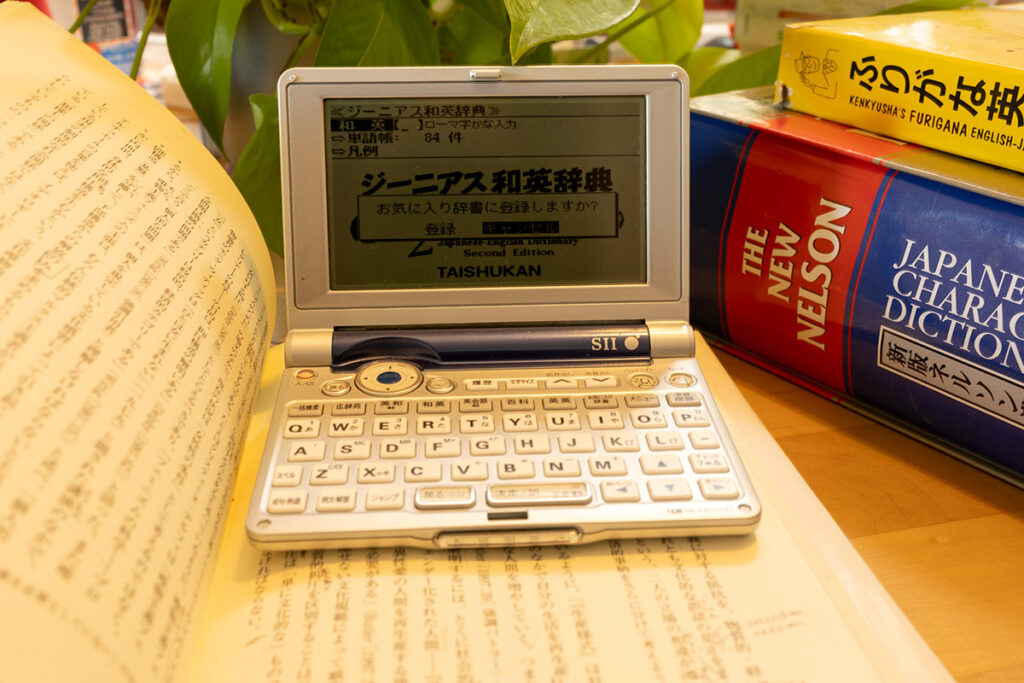
Rather than turning to another phone app or a desktop tab, I reached for my vintage Seiko electronic dictionary, bought during my student days in Japan 20 years ago. While I find paper dictionaries nostalgic, they are simply too slow for a 30-minute immersion session. Remarkably, this 20-year-old piece of technology still works perfectly. I found myself reading exactly as I did before the days of smart phones—no software updates required, and zero pop-up ads.
The device features a “Sil-Card Red” slot for specialized, SD-sized cartridges. While I don’t have the need for one of these cartridges today, there is a sense of permanence in this technology. If I did have one, it would likely still function without needing a server or a tech company’s permission. It is a beautifully distraction-free tool in a world where every other app competes for my attention. It’s disconcerting how much modern technology promises, yet we seem to own less of it than ever before. My smartphones eventually become obsolete or “brick” when support ends, but this Seiko remains a tool I truly own.
The only “distractions” the machine ever offered were the options for 夢占い (dream fortune-telling) and 相性事典 (compatibility dictionary) cartridges. On my student budget, I stuck to the pre-loaded academic dictionaries.
While the world moved on to cloud computing and ephemeral licenses, this device remained. It’s the same one that navigated the surreal landscapes of Murakami with me years ago; today, powered by two simple AAA batteries and a logic that doesn’t expire, it’s simply waiting for the next page of The Izu Dancer.