Skip to content
  • The Friction of Nourishment

    As part of my attempt to be more mindful of my actions and surroundings, I have become increasingly aware of what I eat over the last few weeks. I feel fortunate to have grown up in the countryside at a time when processed food was not widely available. Back then, I saw firsthand what it took to put food on the table: I watched chickens pecking at the ground, saw little chicks hatch, and played with the neighbors’ piglets. This was during my early childhood, long before I knew anything about industrial farming. In the Taiwan of the 1980s, processed food simply wasn’t common in rural areas. Since “screen time” wasn’t a thing yet—Taiwan had only three television channels—watching plants and animals grow was as good as entertainment got. It was a great experience, though I must admit, I have no desire to live in the countryside today.

    It is easy to be mindless about our diet these days, as processed food provides all the convenience of modern life. While there is plenty of literature discussing why one should opt for whole foods and the health benefits of avoiding industrial nourishment, I became curious about something simpler: what does food in its original form actually taste like?

    My first experiment was with fermented cacao nibs, the least processed form of chocolate I can find here in North America. These are easy enough to find at the supermarket, but the taste is nothing like the commercial chocolate sold in stores. Nibs are crunchy, chalky, and slightly bitter; they require effort to grind down with your teeth and certainly don’t “melt in your mouth.”
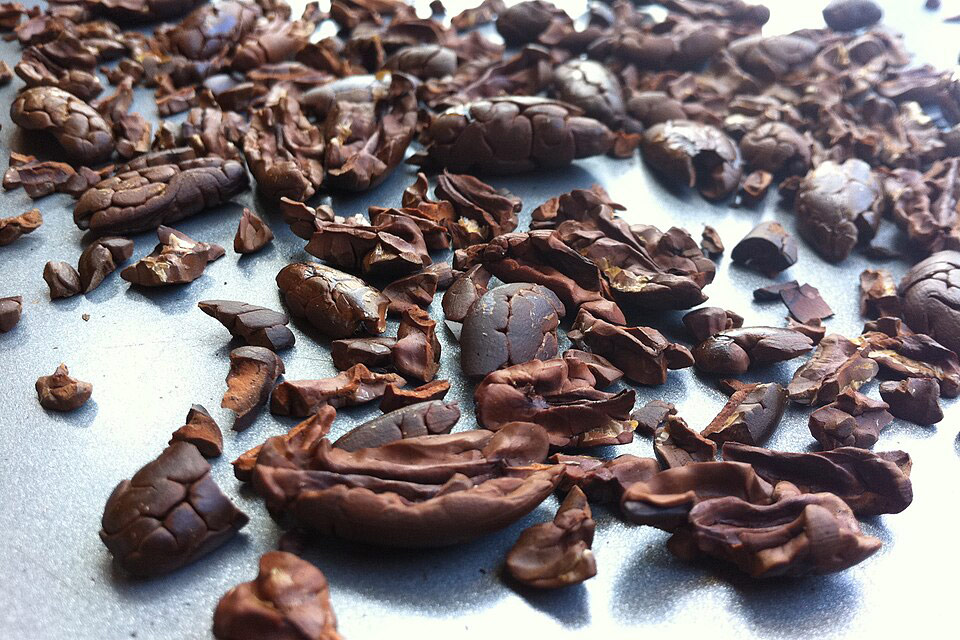
    A close-up, high-angle shot of dark, roasted cocoa nibs scattered across a grey surface, showing their irregular, crunchy, and chalky texture.
    Image: Roasted cocoa nibs by Michael, licensed under CC BY 2.0.

    When I showed the package to a colleague and asked if they had tried them, the answer was a “yes” accompanied by a bit of disdain for the taste. We ended up discussing how the chocolate-making process requires days of “conching”—a refined grinding process—to ensure the texture becomes smooth enough to achieve that melt-in-the-mouth sensation consumers crave. My colleague reminded me that chocolate has a history stretching far back before the modern bars I’m accustomed to. Our conversation shifted to the sheer genius required to figure out which plants were edible, and how to process them so they became palatable—or even safe—for human consumption.

    I am in awe of this human ingenuity. So many brilliant people before us figured out how to turn unpalatable raw materials into something delicious and sought after, even if that processing now comes with health consequences. I admire the spirit of those who took a toxin-heavy plant like cassava and transformed it into a staple food—and eventually into the bubble tea pearls so iconic to Taiwan. I can’t help but ask: how does an indispensable staple food for the peoples of Africa and South America turn into a confectionery beverage in Taiwan? There is a wealth of food history there that I have yet to uncover.

    It takes immense trial and error to transform plants into something pleasing to the palate. It requires time to master the “kitchen chemistry” of artisanal sourdough or any number of other foods. Yet, ironically, this very history of refinement is now fueling a modern epidemic of ultra-processed health issues.

    I still like refined carbohydrates. Sourdough bread, cakes, pastries, and bubble teas are all delicious. There are layers upon layers of food industrialization that remain invisible to me. I am also aware that even my fermented cacao nibs come with their own marketing—touted for antioxidants and polyphenols—and involve complex processing and logistics before reaching my grocery shelves. While I can’t single-handedly solve food inequality or the epidemic of ultra-processing, I can take the time, once in a while, to simply taste food in its closest resemblance to its original form. I’ll let the crunchy, chalky texture of cacao nibs remind me of the friction my ancestors endured to smooth out the path to our modern nourishment.

    April 11, 2026
    Food History, Human Ingenuity, Metabolic Health, Mindfulness

  • From ㄅㄆㄇㄈ to Zeit-spar-kas-se

    The ‘Grey Men’ of the language learning community are obsessed with speed. They promise that their methods will help me reach fluency in record time—B1 in three months, speaking in weeks—if only I use their system. But as I read Momo, I realized that my own process is a stubborn, forced slowness.

    After more than two months of struggle, I finally finished Momo in German. Honestly, it was a bit beyond my current reading level, but it was recommended by a dear friend and I felt I had to read it. I encountered a lot of unfamiliar vocabulary and found myself re-reading sentences multiple times to grasp their meaning. Yet, I persisted without turning to an English translation. I made sure my eyes lingered over every word, sounding out each syllable even though I knew my pronunciation was quite accented and may not always have been correct. Knowing the importance of hearing the word while reading, I tried to follow along with the audiobook narrated by Gert Heidenreich. However, my pace was painfully slow compared to his. I eventually had to let the audio go so I could focus on sounding out the words one by one.

    There were moments of pure joy when everything on the page suddenly clicked, but there were also times I had to simply move on; looking up every single word would have been far too time-consuming. I was living in that realm of the Nirgend-Haus—the “Nowhere House”—where one must sometimes step backward to get forward.

    Denn Zeit ist Leben. Und das Leben wohnt im Herzen. (p. 64)

    Because I couldn’t understand every word, I focused on the mood, the atmosphere, and the rhythm of the language itself. Unlike reading in English—where I can skim—or Chinese—where I can scan pictographs for a quick overview—German currently requires a slow subvocalization. Every syllable felt like a second passing, or a single heartbeat. It gave me a child-like immersion into the fairy-tale world of Das Nirgend-Haus and a contrast to the rushed, frantic world of the “Grey Men.”

    Es gibt ein großes und doch ganz alltägliches Geheimnis. Alle Menschen haben daran teil, jeder kennt es, aber die wenigsten denken je darüber nach. Dieses Geheimnis ist die Zeit. (p. 61)

    There is something truly comforting in this slowness. It is fine that I’m not going to be fluent in nine months or reach B1 anytime soon. An aspect of language learning has historically been tied to the prospect of financial rewards, whether it’s better job placement or the ability to travel and consume. Sounding out every word in my mind is my way of living the language. It is the same way I sounded out Chinese characters with ㄅ, ㄆ, ㄇ, ㄈ, or guessed the meaning of an individual symbol by looking at the characters around it as a child in Taiwan.

    As a beginner, I cannot skim or make assumptions about a passage. I have to weave an image of the world syllable by syllable:

    A-ber wie-der kehr-te das Ster-nen-pen-del um, und die Herr-lich-keit ver-ging und lös-te sich auf und ver-sank, Blatt für Blatt, in den un-er-gründ-li-chen Tie-fen des schwar-zen Tei-ches. Lang-sam, lang-sam wan-der-te das Pen-del zu-rück auf die Ge-gen-sei-te, a-ber es er-reich-te nun nicht mehr die-sel-be Stel-le wie vor-her, son-dern es war um ein klei-nes Stück wei-ter-ge-wan-dert. Und dort, ei-nen Schritt ne-ben der ers-ten Stel-le, be-gann a-ber-mals ei-ne Knos-pe auf-zu-stei-gen und sich all-mäh-lich zu ent-fal-ten. Die-se Blü-te war nun die al-ler-schön-ste, wie es Mo-mo schien. (p. 180)

    The slowness in sounding out the opening of Stun-den-blu-men is fine for me for now. As Beppo the Sweeper says:

    Man muss nur an den nächsten Schritt denken, an den nächsten Atemzug, an den nächsten Besenstrich. (p. 38)

    With each breath, I will just tackle one syllable at a time:

    Ich muss nur die nächste Silbe lesen, an den nächsten Atemzug denken, das nächste Wort fühlen.

    February 28, 2026
    German Learning, Michael Ende, Mindfulness, Momo, Philosophy Of Time

  • Unfinished Japanese

    Every time I come across a mention of the Japanese language, a sense of guilt swells up. It was a language that defined a significant part of my life in the late nineties and early two-thousands, but I’ve since let it lapse. I haven’t put in the effort to keep it up. Occasionally, I’ll find myself on a sudden “kick” to read or write in Japanese, but I can never sustain it the way I’ve managed with my German.

    I can’t quite rationalize this guilt or pinpoint its source. Perhaps it’s the same feeling that arises when I spend too long knitting instead of doing something “productive”—like learning to code or acquiring a monetizable skill. Or perhaps the guilt comes from the timeline: Japanese has been part of my life for over two decades, yet I am content with having passed the N2 exam without striving for more. Still, a nagging feeling persists that I should want more.

    Perhaps, however, learning a language isn’t about achieving N2, N1, or reaching the B2 or C2 levels of the CEFR. Maybe what is truly nagging me is the fact that my Japanese studies were once so entangled with the pressure of grad school and scholarship applications. While I was attracted to the literature and culture, the language became a tool to prove my worth to others rather than a space for personal appreciation.

    Though I knew the concept of 一期一会 (ichigo-ichie)—the idea of a once-in-a-lifetime encounter—I wasn’t able to apply it. I failed to live in the present or cherish the unique experience of the language itself. My ability was always being evaluated against how it could benefit me, rather than being acknowledged for its own sake.

    I see now that it would have been better to be mindful—to study for the process rather than the surrounding benefits. Because my study was always a means to an end, it was done in such a hurried manner that I don’t remember the joy of making connections with words, a joy I feel so clearly now with German and even Italian.

    Perhaps, one day, Japanese will become an active part of my life again. If that day comes, I’ll be sure to embrace the process—not for a scholarship or an application, but simply for the love of understanding and the quiet discovery of new things.

    January 12, 2026
    Japanese, Language Learning, Mindfulness, 一期一会

  • Day 471 of German: Forgetting Myself

    It feels like a joke, but a few days ago, on Halloween, I finished Duolingo’s German course. The realization didn’t hit me until a couple of days later on my bus commute when I wondered why I was no longer getting new lessons. A quick check confirmed it: the course was complete, and now I’d only be getting reviews.

    This was both disappointing and a relief. The relief comes from not feeling compelled to renew the subscription—my child and I received a year of Super Duolingo as a gift, and my child isn’t keen on language learning. While we’ll still maintain the streak (for reasons I can’t quite articulate, but we will), the pressure is off.

    I’m actually not a big fan of the Duolingo learning style—the fill-in-the-blanks and translation drills. While declensions are important, I prefer using materials targeted for native speakers, like watching the Tagesschau or reading Momo, even if I miss a lot of information. I don’t need to understand everything, just as I didn’t understand everything adults said when I was a child.

    To maintain the streak, I started Italian because the German reviews felt boring. In doing so, I made a bigger realization: language learning itself is a form of meditation for me.

    That feeling of focusing on a new word and absorbing it is like breathing. During the short two-minute lesson, I felt selfless. I was just absorbing those five or six words Duolingo presents. After learning simple terms (Per favore, Grazie, Tè, Caffè, Zucchero), I felt surprisingly content, even though I have no serious intention of learning Italian.

    The Active Emptiness
    The biggest realization is that I am using language acquisition as a meditative practice. Unlike conventional meditation, which asks the mind to empty itself and passively observe, language learning requires me to actively empty my mind of distraction to be present.

    Work fatigue, life responsibilities, and chores instantly vanish. My attention is wholly given to the sound of “tè, per favore” or to understanding why kontrollieren means to control in one German context but to scrutinize in another. It’s an unconventional form of mindfulness, but one that holds deep meaning for me. In that moment, I’m removed from myself and transported to a realm where I am solely focused on understanding something that has nothing to do with my daily obligations.

    No, I’m not going to learn Italian seriously—at least not until my German reaches a B2 level. But those quick two-minute lessons show me how precious it is to let the mind be empty and receptive to whatever comes.

    November 4, 2025
    German Learning, Meditation, Mindfulness, Selfless Absorption

  • The Buddha on the Ledge: Between Practice and Philosophy

    Day 464 of German

    Just a block from my home, on a busy street, is a small, unassuming temple—so discreet one could drive right past it. Across the street is a church that, while understated, is more obviously a religious institution than the temple.

    I am fully aware that inner peace is earned through effort, not granted by outside authorities. However, for my own mental health, I find it extremely calming simply to look at the image of the Buddha sitting. Outside this temple, there is a square concrete cauldron, usually with incense burning, and a small green Buddha statue sitting calmly on its ledge. Because the Buddha is outside, I can visit at any time.

    The Contradiction of Craving
    The act of going to the temple to calm myself, however, highlights a deep contradiction. In East Asia, cultural practice often involves supplicating (asking) Buddhist deities for blessings, prosperity, career success, and protection against adversity. As my father taught me in his explanations of Buddhist scripture, the very act of wanting is a form of delusion and the great cause of pain.

    Going to a temple to ask for blessings is thus fundamentally contrary to the core Buddhist teaching of recognizing impermanence and understanding emptiness.

    This contradiction brings to mind the Diamond Sutra:

    凡所有相,皆是虛妄。若見諸相非相,則見如來

    (All things that have characteristics are false and ephemeral. If you see all characteristics to be non-characteristics, then you see the Tathāgata.)1

    As a result, when I offer incense, I rarely know what to say, and certainly don’t ask for conventional success. For now, when I see that little statue, I use it as a reminder: I am not here to ask for blessings or pray for things I have not worked for. The image of the Buddha sitting calmly is a reminder that I need to take the time to understand philosophical Buddhism. Perhaps through that struggle, I can renounce more of the trappings of conventional wants and desires.

    1. Section 5, The Diamond Sutra, translated by A. Charles Muller: http://www.acmuller.net/bud-canon/diamond_sutra.html#div-6 ↩︎

    October 23, 2025
    Buddhism, Cultural Buddhism, Impermanence, Mindfulness, Non Attachment

  • The Protective Filter: News and Detachment in a Second Language

    I woke up to the news that the Japanese parliament just elected its first female prime minister, Sanae Takaichi (高市早苗). This is a laudable event, one I couldn’t have foreseen when I was a student of Japanese literature and culture in the early 2000s.

    Earlier this year, I stopped consuming current events in my strongest languages, Mandarin and English, choosing to eliminate inputs that did not clearly add value or personal growth. As Nassim Taleb states (I believe in Antifragile, though I can’t recall the exact quote)1, what one chooses not to do is often as crucial as what one chooses to do when managing one’s well-being.

    However, I do watch news clips in German and Japanese. Since my Japanese is much stronger than my German, I tend to focus more heavily on the German news. There is something profoundly cool and contradictory about processing news in a second language.

    Things that might easily rile me up in my dominant languages seem to lose their sharp emotional edge when expressed in German. I feel almost like a child learning about complex adult issues, trying to figure out why the world is so upset. Conversely, if I am upset about something, trying to express that negative feeling in German immediately makes the emotion feel distant and easier to manage.

    This distancing effect brings to mind lines from the Heart Sutra:

    不生不滅。不垢不淨。不增不減

    是故空中無色。無受想行識

    (Roughly: Not created, not destroyed. Not tainted, not pure. Neither increasing nor decreasing. Therefore, in emptiness, there is no form, no feeling, perception, mental formation, or consciousness.)

    See Thich Nhat Hanh’s new translation of the Heart Sutra here

    While I’m not sure if the concepts are logically related in a Buddhist sense, acquiring information through a non-dominant language allows me to process it without being so tainted by worldly constructs and intense emotion.

    I know the news of a female Japanese prime minister would have stirred strong hopeful emotions in me back when I was a student in Japan. But today, processed through the lens of a second language, it feels strangely neutral—a significant event observed, but one that does not claim my emotional energy.

    1. This concept is discussed by Nassim Nicholas Taleb in Antifragile: Things That Gain from Disorder, where he argues for the heuristic of avoiding harm (negative inputs, stress, excess information) as the key to well-being, often citing the wisdom of via negativa. See pages 126-127 and pages 360-361. ↩︎
    October 21, 2025
    Detachment, Heart Sutra, Language Filter, Mindfulness

  • Evie’s Warmth: Tracing the Yarn’s Origin

    I missed a recent farm and studio event hosted by Fibre & Forge, a local sheep farm in Abbotsford, BC. I would have loved to visit the animals and learn about the wool accessories, candles, and yarns they produce.

    The farm’s website features photos of their sheep, and on the corresponding page, skeins of naturally undyed yarn are named after the animal the wool came from. I love the concept of tracing the source of the fibre down to the specific sheep.

    If I could have attended, I would have certainly picked up a couple of skeins of Evie 2019. I imagine printing out a photo of Evie the sheep to keep alongside the yarn, where each stitch would then carry her warmth.

    It is rare in modern life to be able to trace the source of the goods one uses so directly. I’m glad this kind of connection to local production is still possible in my local community.

    October 18, 2025
    Connection To Source, knitting, Local Production, Mindfulness, Provenance

  • From Heart Sutra to “How to Sit”: The Tools We Pass Down

    I almost always have a digital copy of Thich Nhat Hanh’s How to Sit open on my laptop. It’s part of the Mindfulness Essentials Series—easy to read, with each page presenting a single concept in an accessible manner. I often read a passage at work or during quick breaks to recenter myself.

    My child recently saw the title and, missing the metaphor entirely, said, “But you already know how to sit.” I found this adorable. To get a reaction, I looked up another title, How to Smile, and showed it to them with a contorted, fake smile, asking if I should borrow it. The “WTF” look on their face was priceless.

    The humor reminded me of my own journey into Buddhist philosophy. At my child’s age, my own father was deeply immersed in Buddhist texts. His way of introducing me to the Dharma was through the Heart Sutra. I had to use a calligraphy brush to copy out the Sutra daily during summer break. This was meant to cultivate mindfulness, but I resented the long, dry process of writing complex traditional Chinese characters.

    Eventually, my father took the time to explain the Sutra’s meaning on weekends. The Heart Sutra is a text of immense depth, and while I only glimpsed its full meaning, the core concepts of impermanence and emptiness took root, allowing me to appreciate life’s ephemeral nature—a theme that runs through many of the Japanese literary works I love.

    In retrospect, I can’t say I enjoyed my introduction to philosophical Buddhism. Yet, it did fundamentally shape me, giving me the philosophical tools to cope with adversity. I realize I am the most mindful precisely when things are not going right.

    My child is being raised in a secular environment, and I won’t force them to copy Buddhist texts. However, I want them to have access to these philosophical tools for the inevitable adversities of life.

    Perhaps the simple solution is to have the physical copies of Thich Nhat Hanh’s accessible “How to” books lying around. If not for the philosophical wisdom, perhaps they can at least learn to appreciate the poetic device of the titles.

    October 17, 2025
    Heart Sutra, Impermanence, Mindfulness, Thich Nhat Hanh

  • Language Study as a Mental Anchor

    These past two days, I was able to dedicate time to going through imported lessons in my LingQ language learning app. I focused on intensive reading by slowly working through the transcript of the video Weltberühmt und depressiv: Sisi, Adenauer & Co. | Terra X History in LingQ.

    I also practiced my listening comprehension by simply listening to So will die EU bei Whatsapp mitlesen: Chatkontrolle erklärt without looking at the screen or the closed captioning. I estimate I understood about 50% of the content, which is encouraging. To grasp what I missed, I still need to import the video into LingQ for a full review.

    My mind is currently preoccupied with delusional worries that I know rationally to abandon, but which I unfortunately lack the wisdom and clarity to dismiss. Learning to simply sit still and stay with my thoughts without letting them take control is a profoundly difficult practice.

    Funnily enough, studying German has become a way to exert control over my own mind. The act of reading, focusing on one word at a time, sounding out every syllable, and appreciating the language forces my concentration onto that single, productive task. It becomes a reliable anchor for my mind.

    October 15, 2025
    Discipline, German, Mental Anchor, Mindfulness, Volition

  • 時知らず: The Quiet Grace of Unseasonal Bloom

    Many years ago, a Japanese seafood aficionado taught me about Tokishirazu Sake (時知らず鮭). Literally meaning “salmon not knowing the season,” this fish is highly sought after in Hokkaido because it returns to its spawning river in the wrong season—spring instead of autumn.

    Unlike autumn salmon, the flesh of the Tokishirazu is highly prized by connoisseurs for being rich and full of delicious fat. Though I’m not a seafood enthusiast and can’t recall the price, I have always found the phrase Tokishirazu (時知らず) beautiful.

    The point of this post, however, is not salmon, but my Clematis montana ‘Elizabeth’. This vine normally flowers only in late spring, but this autumn, it is blossoming again. It’s a handful of flowers scattered across the vines that are currently wrapping around the stair railing. I have been meaning to cut it back, but my laziness has prevailed, and online literature suggests against pruning this variety anyway, as it blooms on old wood.

    Clematis Elizabeth blooming in the autumn
    時知らず Clematis montana ’Elizabeth’ blooming out of season in autumn

    I’ve grown tired of gardening. Over the past five years, I tried to cultivate various colourful clematis varieties in the same spot, aiming for continuous bloom from spring to autumn. Most of those efforts failed due to mislabeling or the plants simply not surviving. Only the unruly ‘Elizabeth’ variety remains, with its relatively short two-to-three-week blooming period.

    Yet, these unexpected, Tokishirazu blossoms are giving me second thoughts about cutting the vine back. While I no longer appreciate the plant with the enthusiasm of its first bloom, this quiet, unseasonal persistence compels a different reaction. When the time comes to prune, I think I will be gentle.

    October 14, 2025
    Mindfulness, Minimalist Growth, Persistence, 時知らず

  • The Peaceful Discipline of Neglect

    I used to be intensely focused on gardening and caring for plants, acquiring numerous houseplants during the pandemic. I was excited to watch new leaves unfurl, built shelves, installed plant lights, and observed their movement toward the sun. Over time, through life events, sickness, and new interests, my intense focus faded. I also began questioning the wisdom of keeping tropical plants indoors in temperate climates. While I maintained minimal care, many of the plants quietly died—and I was, frankly, relieved. Of eight types of peperomia I once owned, only one survived, and only because I gave it away.

    Yet, many of my plants survived my neglect and seem to thrive despite it. Many of these are trailing varieties that have stretched themselves over meters. They grow silently across the room and often droop down into inconvenient spots, forcing me to pin their extending leaves to the wall or ceiling.

    Watering the plants has become a chore; I no longer do it with enthusiasm, counting every new leaf or observing fresh growth. Repotting and rerooting are burdens now. But as I watch the greens quietly stretch and claim space across the room, I can’t help but admire that peaceful spirit of growth.

    I change, my interests change, but the plants continue their slow, quiet, and minimalist growth—a quiet discipline that merely requires basic sustenance to persevere.

    October 13, 2025
    Discipline, Mindfulness, Minimalist Growth, Persistence

  • A Page of Peace: Dharma Through German

    Day 452 of German

    Today is another workday, which means I have to be disciplined to fit German study into a tight schedule. When pressed for time, I usually limit myself to reviewing Tagesschau or completing a couple of lessons in LingQ (my subscription language learning software). Naturally, this meant I wasn’t able to dedicate time to reading Momo (my intensive reading exercise) today.

    I am continuing to read Thich Nhat Hanh’s How to Dream. I found this book serendipitously in a bookshop on Granville Island last Sunday afternoon. I’ve deliberately limited myself to reading only a page a day, hoping to stretch the enjoyment out for approximately 100 days (the book has 116 pages, many of which include illustrations).

    It may seem strange, but being able to read and listen to a language proficiently is a personal dream of mine. It feels both nice and appropriate to pursue this language acquisition journey with the guidance of the Dharma.

    Though I was raised in a Buddhist country, I often found traditional Dharma texts dry and inaccessible. I deeply appreciate Thich Nhat Hanh’s writing; it is easy to read, understandable, and brings a genuine smile to my face. I’m happy to have this accessible Dharma text accompanying my daily efforts to acquire German.

    October 11, 2025
    German, Mindfulness, Motivation, Thich Nhat Hanh, Volition

  • Just Listening

    My child was quiet. From my perspective on the top bunk, I saw the headphones and assumed they were plugged into an iPad. I asked, “What are you watching?”

    Raising a portable CD player we bought years ago at a yard sale for 25 cents, they answered, “I’m just listening to music.”

    How cool is that?

    I should try that. The pure act of just listening to music.

    No doing the dishes. No putting laundry away. No planning or thinking. Just sitting, being present, and listening. Nothing else.

    October 9, 2025
    Daily Life, Focus, Mindfulness, Presence, Simplicity

Powered by
►
Necessary cookies enable essential site features like secure log-ins and consent preference adjustments. They do not store personal data.
None
►
Functional cookies support features like content sharing on social media, collecting feedback, and enabling third-party tools.
None
►
Analytical cookies track visitor interactions, providing insights on metrics like visitor count, bounce rate, and traffic sources.
None
►
Advertisement cookies deliver personalized ads based on your previous visits and analyze the effectiveness of ad campaigns.
None
►
Unclassified cookies are cookies that we are in the process of classifying, together with the providers of individual cookies.
None
Powered by